


Motorcycle Nod or Wave, the facts

Updated: Jul 18
Have you ever wondered whether you should nod or wave when you pass another motorcyclist travelling in the opposite direction?
Or perhaps you've noticed other riders doing it and wondered what it actually means.
The simple answer is that it's a way of acknowledging a fellow rider and saying, "Hello, ride safe", but like many traditions in motorcycling, there's a little more history and meaning behind it.
For many riders, the nod or wave isn't just a greeting. It's a sign of respect, a recognition that you're both part of a unique community that understands the freedom, challenges and enjoyment that only riding a motorcycle can bring.

If you have ridden in different countries, you will have noticed that the greeting often depends on which side of the road people ride on.
In the UK, Australia and other countries that ride on the left, riders generally prefer the nod. The rider's right hand is on the throttle and nearest the oncoming motorcycle, so taking it off the handlebars isn't practical or particularly safe.
Across most of Europe, North America and many other countries where traffic keeps to the right, the left-hand wave is far more common because the clutch hand is nearest the approaching rider and can usually be lifted safely for a brief greeting.
Ultimately, whether you choose a nod or a wave doesn't matter. What matters is acknowledging another person who shares your passion for riding.
The Nod
As mentioned earlier the nod is more commonly used in countries that drive on the left and usually consists of a single nod forward although there are those who prefer a single nod to the side or a lopsided nod as if you are winking or looking down at the left mirror.
This also has the advantage of leaving both hands on the controls therefore it can be considered safer than a wave.
Nod Origins
There are few suggestions of where the nod originates from, but the most likely especially in the UK is the old motorcycle "noddy" course at the UK Police Force Driving School when the Police put hundreds of officers on two wheels in the late 1950s, many of them with no motorcycling experience.
The two-week "noddy" course at the police’s Hendon Driving School taught them the tips of motorcycling, including nodding to their senior officers rather than letting go of the handlebars to raise a salute and hence the "noddy" course.

Gordon Newton WW2 Veteran and Chief Superintendent and Commandant of the Hendon Police Driving School was the first instructor of the ‘noddy’ course and hence his nickname "Noddy" Newton.
There is another suggestion that the nod originates from medieval knights, whom if approached by another knight bearing the same coat of arms, both Knights would nod to acknowledge to each other. Although many suggest the nod is just an extension of the wave but adapted in countries that ride on the left.
The Wave
In countries where traffic drives on the right, the wave is generally the preferred greeting.
The classic biker wave is performed with the left hand held low beside the motorcycle while extending the index and middle fingers in a "V" shape.
Many riders say the two fingers symbolise "Keep two wheels on the ground." Others simply see it as a variation of the peace sign.
Of course, there are many versions of the wave depending on the motorcycle and riding position—a low wave, raised hand, or simply lifting a couple of fingers from the clutch lever.
There isn't a right or wrong way.
Wave Origins
There are various versions of how the biker wave came to be but the most popular is believed to originate from 1904 when Arthur Davidson and William Harley were passing each other on the road and they waved at each other. It was noted by a passer-by and believed to be etiquette among riders, or so the tale goes.
Another version comes from the surge of returning war veterans after WWII, who bought military surplus motorcycles in droves. The abundance of motorcycles and the solidarity among veterans gave birth to the biker culture as a whole, and motorcyclists in those days were eager to greet each other with a wave on the road. It wasn’t just as a biker thing, but also as a war veteran thing.
The Leg Wave
There is another form of acknowledgement that has become increasingly popular over the years when overtaking another motorcyclist in the same direction
Instead of lifting a hand from the handlebars, a rider briefly extends their leg away from the motorcycle after being overtaken by another rider. It's a simple way of saying "Thank you" or acknowledging the rider behind.
You'll often see this when someone has moved over to allow another motorcycle to pass safely, especially on winding roads where taking a hand off the handlebars may not be practical.
The leg wave is also common among groups of riders and is frequently used on long-distance tours, particularly across mainland Europe. Like the traditional nod or wave, it's another example of the mutual respect and camaraderie that exists within the motorcycling community.
As with all rider acknowledgments, it should only be used when it is safe to do so. If road conditions, traffic or weather require your full concentration, keeping both feet on the pegs is always the safest option.
The Wave or Nod is not returned
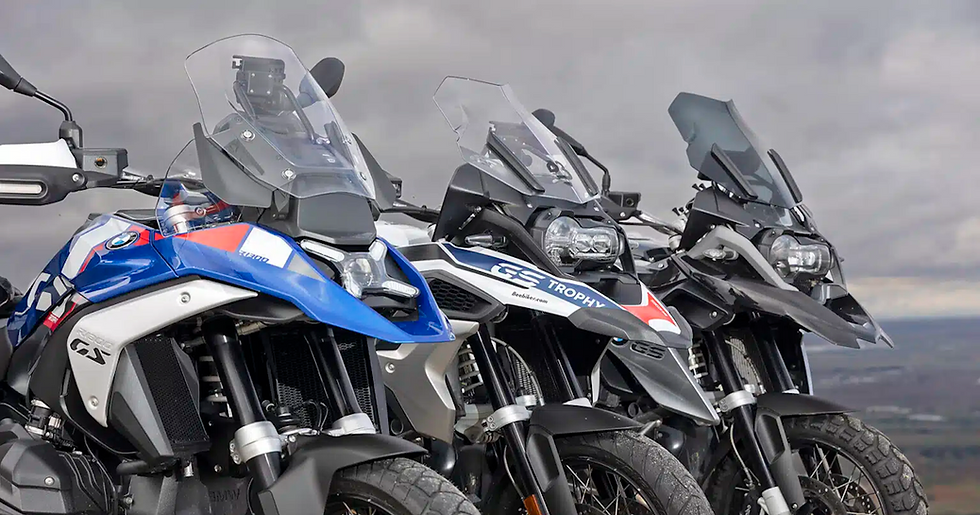
Just know that there will be some occasions when you will not get a return wave or nod and there is plenty of discussion and humour on this matter as to why, for example it is said that Harley Davidson riders will only acknowledge other Harley Davidson riders, the same applies to BMW riders, or sports bike riders, as well as what country you are in.
Although in my experience it’s the same no matter what country and what you ride and the large majority of all riders do acknowledge a wave or nod.

If the wave or nod is not returned do not feel offended as there may be mitigating circumstances such as road conditions, changing gear, avoiding an obstacle in the road, looking in their mirror etc., or they may be a new rider and do not feel safe enough to take a hand off the handlebars.
It is also important to remember that you may not be able to return a wave due to road conditions as staying safe is the most important part of riding.
So when you are out on the road enjoy yourself, and say hello to your fellow bikers as you pass each other whenever safely possible.
When Not to do the Wave or Nod
If you need to use the Controls
Do not wave when you’re in any situation where you’re using, or might have to use, your controls. Whether you’re changing down into a corner or if there is even a possibility you’ll need your hand on the clutch lever, then don’t wave if you need to focus on your controls a simple Nod will suffice as an acknowledgement.
When Turning a Corner
Even if someone else waves at you, don’t interrupt your concentration just to return the wave. Just focus your attention on the turn as opposed to trying to wave at a fellow rider or a simple Nod will suffice as an acknowledgement.
While in Rush Hour or Commuting
On a weekday morning, riding to work on your bike in heavy traffic, battling it out with all the inattentive drivers crowding the roads. Acknowledging another rider might be pretty low on your list of priorities so It’s okay to not wave while commuting to or from work. So lets just all get where we need to be in one piece (and maybe I’ll catch you on the weekend.)
On a Motorway or Highway
When you pass a rider going the opposite direction on the motorway or freeway, by the time you may wave back, you will have passed me anyway, or there are too many cars on the road and your wave could be misinterpreted as a signal to other drivers.
In the Evening or at Night
Visibility is usually an issue in the evening or at night and the last thing you should do is try to get another rider’s attention.
During Extreme Weather, Rain or Snow
Again visibility is usually an issue and chances are the other rider won’t see you wave, so don’t bother.
At Crossings or Intersections
This one depends how you’re stopped. If you have your clutch pulled in with your hand at a red light when you see another rider, you might acknowledge him, but not with your left hand. Throw a wave with your throttle hand perhaps, or simply a nod of the head.
On the other hand, if you’re stopped in neutral, and just waiting for a green light, wave however you want; maybe even say hello if they pull up right next to you. Just make sure your main focus is on the road, the changing lights, and all the cars passing through that could run a red light at any given moment.
Small Scooters or Mopeds
This is one subject guaranteed to divide opinion.
Personally, when riding through towns and cities, I don't usually exchange greetings with smaller scooters or mopeds. In my experience, many are used purely as transport rather than as part of the wider motorcycle community.
That said, there are plenty of scooter riders who are enthusiastic motorcyclists, too, and many larger-capacity scooters are ridden by experienced touring riders.
Ultimately, whether someone rides a sports bike, adventure bike, cruiser, tourer, or scooter, courtesy on the road is always welcome.

More Than Just a Wave
The motorcycle nod or wave is about far more than simply saying hello.
It represents mutual respect.
It reminds us that we all face the same hazards, enjoy the same freedom, and understand the unique feeling that comes from travelling on two wheels.
As motorcycle technology continues to evolve—with advanced rider aids, electric motorcycles, and ever-improving safety equipment—the tradition has remained unchanged. It's one of the few customs that connects riders across generations, countries, and cultures.
Whether you're riding a classic British twin, a Harley-Davidson, BMW GS, Ducati, Honda, a Yamaha, or anything in between, we're all united by the same passion.
After more than 40 years of riding motorcycles and guiding tours across Europe and beyond, my own approach is simple.
I nod or wave to everyone whenever it's safe to do so.
I don't care what motorcycle you ride, where you're from, or how experienced you are. If you're out enjoying life on two wheels, you're part of the same community.
And if someone doesn't wave back?
No problem.
It certainly won't spoil my day or my ride.
Ride safe, enjoy every mile, and don't forget to acknowledge your fellow riders whenever you can.
If you'd like to experience the camaraderie of riding some of Europe's finest roads with like-minded riders, take a look at our guided motorcycle tours in Andalucía.



Comments